Need some help? Contact us
Need some help? Contact us
a2 Milk®
Lactose Free
a2 Milk® Lactose Free, naturally A1 protein free milk that is also lactose free. Available in selected Coles, Woolworths and independent supermarkets.
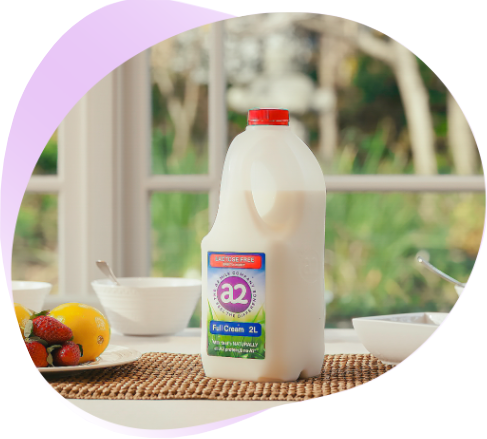
a2 Milk® with naturally no A1 protein, and no lactose.

The great taste, nutritional benefits, and creamy texture of real dairy milk.

*a2 Milk® Lactose Free may be easy to digest compared to ordinary milk for some people who are sensitive to lactose, when consumed as part of a healthy, varied diet.

Lactose free milk is a dairy milk option for people who have difficulty digesting lactose, a natural sugar found in milk.
How is it created?
To create lactose free milk, regular cow's milk is specially treated with an enzyme to break down the lactose, while retaining the taste, nutritional benefits, and texture of dairy milk.
What’s the benefit of this?
With the lactose broken down, people with lactose intolerance or who prefer a low-lactose diet, may be able to enjoy dairy again. a2 Milk® Lactose Free retains all the essential nutrients found in regular milk, including protein, calcium, vitamins and minerals.
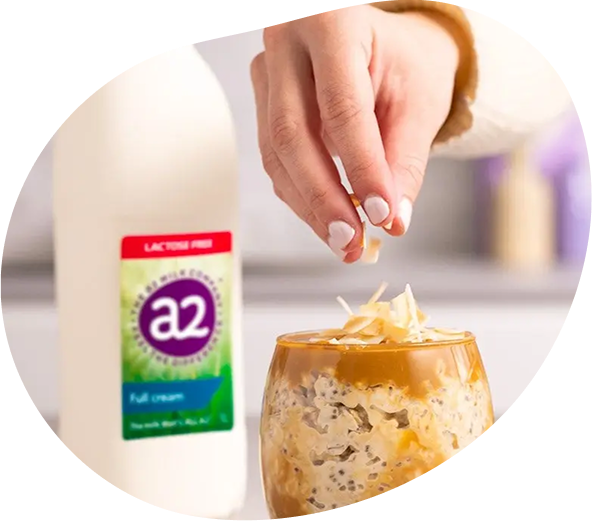
Looking after your gastrointestinal health is important, because your gut is where your body extracts the nutrients it needs for energy and healing. If you have difficulty digesting lactose, you may experience symptoms such as bloating, stomach pain and diarrhoea when consuming ordinary milk. For some people, the benefit of switching to lactose free milk is being able to enjoy the nutritional benefits of milk without these symptoms.
a2 Milk® Lactose Free makes it possible for people who are lactose intolerant to enjoy the nutritional benefits of milk, without the digestive discomfort that may be caused by ordinary milk.
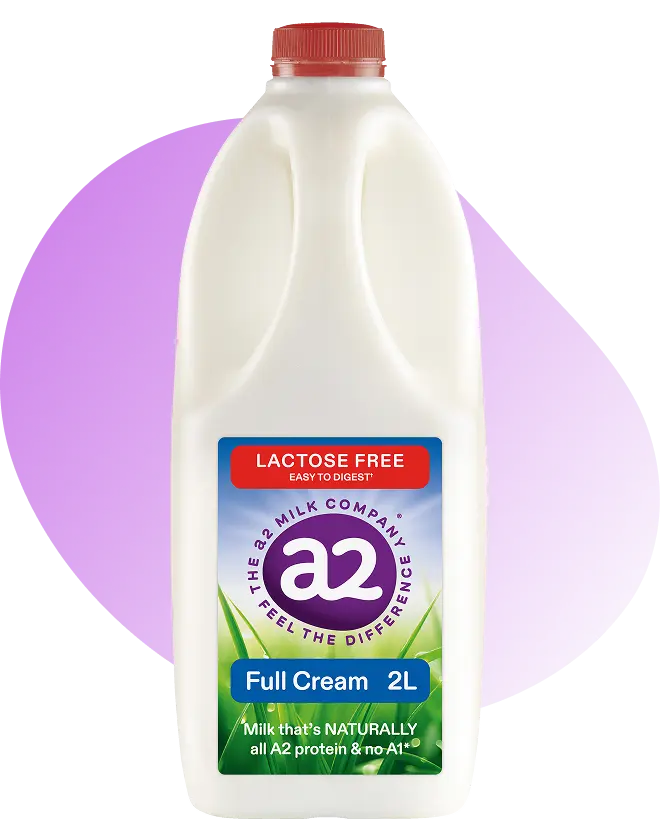
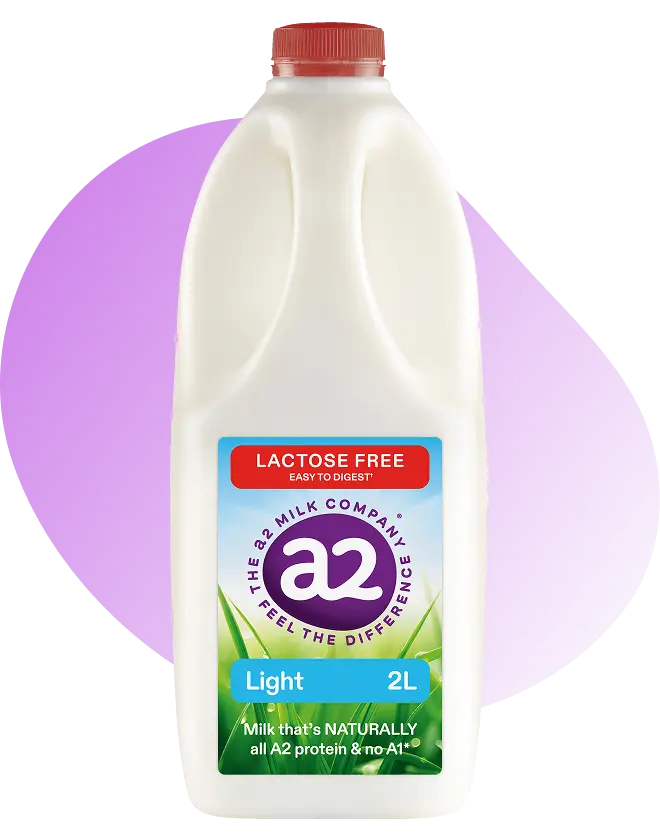
Explore the benefits of lactose free full cream milk or light milk with a2 Milk® Lactose Free Full Cream and a2 Milk® Lactose Free Light.
Love full-bodied, creamy milk? Try a2 Milk® Lactose Free Full Cream. Prefer something lighter? We also offer a2 Milk® Lactose Free Light.
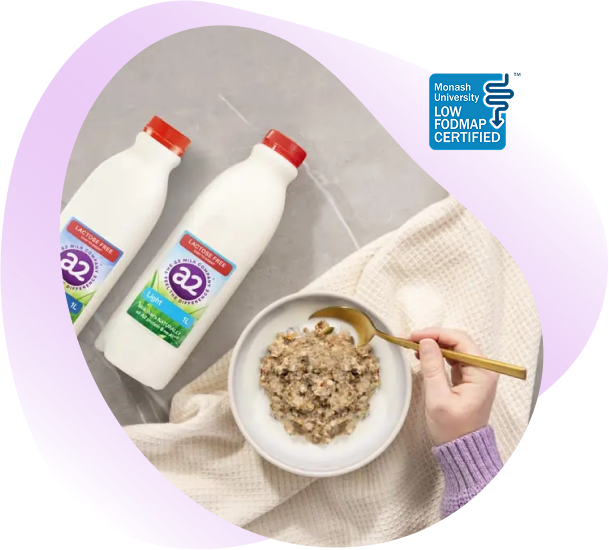
The Monash University Low FODMAP Certification is given to foods that are Low FODMAP. FODMAP is an umbrella term that encompasses several types of carbohydrates. In some people, these FODMAPs can contribute to pain and discomfort when consumed.
Monash University Low FODMAP Certified trademarks are used under licence in Australia by The a2 Milk Company (Australia) Pty Ltd. One serving of a2 Milk® Lactose Free can assist with following the Monash University Low FODMAP diet™. A strict Low FODMAP diet should not be commenced without supervision from a healthcare professional.
Monash University Low FODMAP certification applies only to the a2 Milk® Lactose Free range, due to the absence of lactose and all other FODMAP carbohydrates. All other a2 Milk® products contain lactose and, for this reason, are not Low FODMAP.
Lactose free milk and A1 protein free milk cater to different dietary needs and sensitivities.
Lactose free milk is specifically designed to help individuals who can't completely digest lactose, a carbohydrate (sugar) found in regular cow's milk. By adding lactase enzyme to cow's milk, the lactose is broken down to a level that most lactose intolerant people can drink without experiencing symptoms, whilst still retaining the same goodness and nutritional benefit of dairy milk.
Removing the lactose doesn't change the type of proteins in the milk though, so most lactose free milk still contains both A1 and A2-type beta-casein proteins. This means that people who have a sensitivity to A1 protein may still experience gastrointestinal symptoms from drinking lactose free milk.
Hence, we introduced the a2 Milk® Lactose Free range, that is naturally A1 protein free and also lactose free.
What makes a2 Milk® different from ordinary fresh cow's milk is the absence of the A1 protein. Most ordinary cow's milk brands today contain a combination of two main types of beta-casein protein, namely A1 and A2-type. a2 Milk® is special because it is an exception to this. It is the A1 protein that some people seek to avoid by switching from ordinary cow's milk to a2 Milk®. The a2 Milk Company uses comprehensive herd selection to choose cows which naturally don't produce the A1 protein in their milk.
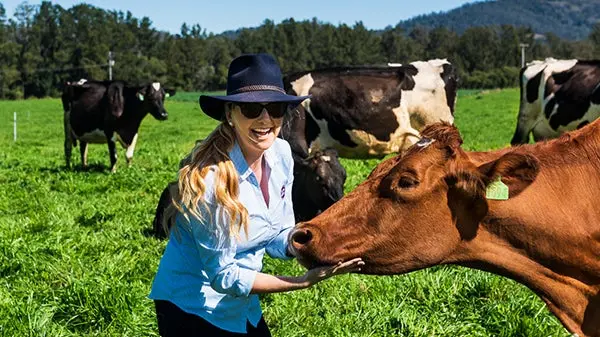
The single most important factor in producing our delicious a2 Milk® is to find the right dairy cows. Our farmers exclusively select cows that naturally produce milk containing only A2-type protein and no A1 protein.
This is done by using a simple genetic test performed on a tissue sample taken from the cows and involves the analysis of DNA to identify cows that naturally produce milk with only A2-type beta-casein protein and no A1 protein.
Yes, a2 Milk® is naturally occurring cow's milk; it's not a result of a technological process or genetic engineering. We simply select cows that naturally produce milk with only A2-type protein and no A1 protein.
a2 Milk® is enjoyed by many across the nation. The welfare of our animals has been a cornerstone of the a2 Milk® success story. Our commitment to high living standards for all animals involved in and impacted by the supply of a2 Milk® is underpinned by a respect for animal welfare, and belief in the positive impact that animal welfare standards can have on milk production and milk quality. Our vision is for a best-in-class animal welfare management system that exceeds Australian dairy industry standards. To help achieve this vision, we engage an independent expert organisation for auditing and certification of the animal welfare management practices on all our farms supplying A1 protein free milk across the nation. More information about our partner, Validus, can be found here.
a2 Milk® does not contain any permeate or any additives, which is why it tastes so refreshing, as real milk should taste.
Yes, a2 Milk® contains roughly the same amounts of calcium and other important minerals as other unfortified milks.
Cow's milk allergy is a serious condition and is different from cow's milk intolerance. If you or your child is known to suffer from a cow's milk allergy, you should consult your doctor or paediatrician before consuming ANY milk variety, including a2 Milk®. All milk contains a variety of biologically active factors known to affect the immune system. a2 Milk® contains all of the proteins that you would find in ordinary cow's milk except for the A1 beta-casein protein. Therefore, those people with allergies to the proteins in ordinary cow's milk will not be able to drink a2 Milk®. However, a2 Milk® may help to reduce digestive discomfort in some people who have difficulty digesting ordinary cow's milk as opposed to having a milk allergy. There is a growing body of evidence that supports the unique benefits of milk containing only A2-type beta-casein protein like a2 Milk®.*
*a2 Milk® is naturally A1 protein free, so it may be easier on digestion than ordinary milk for some milk-intolerant individuals, when consumed as part of a healthy varied diet.
Absolutely not! a2 Milk® is obtained naturally from cows specially selected for their genetic makeup.
Absolutely. All of our fresh a2 Milk® is produced from local cows and supports local Aussie farmers.
Proteins are large biological molecules made up of long chains of amino acids.
Beta-casein is a type of protein that makes up one third of the protein in milk. It is a milk protein that is a source of essential amino acids, as well as peptides.
Homogenised milk has been treated to disperse the cream layer containing the milk fat throughout the milk. Homogenised milk generally has a longer shelf life than un-homogenised milk.
Pasteurisation is a method of heating milk for a short time to kill off bacteria which would cause the milk to spoil.
a2 Milk® is widely available in supermarkets in Australia.
You can find the nutritional information for each of our products here. The nutritional information can also be found on the back label of every a2 Milk® bottle or carton.
You can learn more about our science and testing here at a2Research.org.
People with lactose intolerance often avoid cow's milk and other dairy products, however research has shown that lactose intolerant individuals can usually tolerate up to 12-15g of lactose per day, which is equivalent to 250ml cow's milk. The Australian Dietary Guidelines recommends that this amount of cow's milk may be well tolerated by lactose intolerant individuals when consumed with other foods and spread over the day. Each person with lactose intolerance will have their own level of tolerance. For those wishing to consume a larger daily volume of cow's milk, this should be guided by tolerance, or a lactase enzyme supplement may be taken to assist with a larger volume to be tolerated.
For those who prefer to avoid lactose altogether, there is a2 Milk® Lactose Free, available in both Full Cream and Light options.
None of the farms that supply our delicious a2 Milk® use the Bovaer or Rumin8 supplement.
People with lactose intolerance often avoid cow's milk and other dairy products, however research has shown that lactose intolerant individuals can usually tolerate up to 12-15g of lactose per day, which is equivalent to 250ml of cow's milk. The Australian Dietary Guidelines recommends that this amount of cow's milk may be well tolerated by lactose intolerant individuals when consumed with other foods and spread over the day. Each person with lactose intolerance will have their own level of tolerance. For those wishing to consume a larger daily volume of cow's milk, intake should be guided by individual tolerance. Alternatively, a lactase enzyme supplement may be taken to help improve tolerance to larger volumes.
For those who prefer to avoid lactose altogether, there is a2 Milk® Lactose Free, available in both Full Cream and Light options.
a2 Milk® may be easier on digestion than ordinary milk for some milk intolerant individuals, when consumed as part of a healthy, varied diet. That's because a2 Milk® comes from cows specially selected to produce milk that’s naturally all A2-type protein and no A1. Originally, all cow's milk contained only the A2 beta-casein protein. Owing to a natural mutation, the A1 protein emerged and has spread through dairy herds over time. Most dairy cows in Australia produce milk that contains both A1 and A2-type beta-casein proteins.
a2 Milk® comes from cows that produce milk naturally, without the use of added growth hormones. Our farmers are not permitted to administer growth hormones to cows, and milk is regularly tested through strict Quality Control procedures to ensure it is free from undesirable hormone and antibiotic residues.
a2 Milk® is pure, natural milk without any additives or preservatives and comes from cows specially selected to naturally produce milk with only A2-type protein, and no A1.
You may find that our fresh a2 Milk® has a slightly longer shelf life than some other milk brands. We follow rigorous quality control procedures in the production of a2 Milk® and as a result, fresh a2 Milk® stays fresh for longer and has a shelf life of around three weeks from manufacture.
As an additional layer of assurance, we continuously test our milk quality from the moment it arrives from the farm through to its use-by date. This means we have a very high level of confidence in the consistently high quality and freshness of a2 Milk® until the use-by date. All fresh a2 Milk® is pasteurised as mandated by Australian law.
a2 Milk® may be easier on digestion for some people, including some children with sensitive tummies due to milk intolerances, when consumed as part of a healthy, varied diet. That's because a2 Milk® is made with milk from cows that are specially selected to naturally produce milk with only A2-type protein, and no A1 protein.
a2 Milk® is suitable for the whole family, including during pregnancy and breastfeeding. As is the case for all cows milk, it should not be given as the main drink to infants under 12 months of age.
Our cows are tested to identify whether they will produce milk with only A2-type protein, and no A1. Any breed of cow may have A2/A2-type genetics. Every farm is different, but we have a mixture of Jersey, Holstein Friesian, Guernsey and others in our herds that supply our a2 Milk®. All our cows are tested to ensure they are cows with A2/A2-type genetics, that naturally produce milk with only A2-type beta-casein protein.
There is a growing body of scientific evidence that supports the unique digestive benefits of a2 Milk® for some milk intolerant people. a2 Milk® does not contain A1 beta-casein protein which has been shown to preferentially release the opioid BCM-7 on digestion. a2 Milk® only contains A2-type beta-casein protein and the structure of A2-type beta-casein limits the release of BCM-7 on digestion.
Monash University Low FODMAP certification applies only to the a2 Milk® Lactose Free range, due to the absence of lactose and all other FODMAP carbohydrates.
All other a2 Milk® products contain lactose and, for this reason, are not Low FODMAP.
Homogenisation is a common and safe mechanical process to shake the milk and ensure the fat is evenly dispersed. This helps with consistent creaminess with dairy milk. There is no evidence to suggest there is any significant difference in the nutritional benefits of homogenised milk compared to unhomogenised milk.
The nutritional values of a2 Milk® Full Cream UHT and fresh a2 Milk® Full Cream are very similar. Both products are made with milk from cows that are specially selected to naturally produce milk containing only A2-type protein and no A1, so may be easier on digestion compared to ordinary milk for some milk intolerant individuals, when consumed as part of a healthy, varied diet.
Heating and frothing a2 Milk® does not affect the A2-type protein or protein composition of the milk.
a2 Milk® contains roughly the same amounts of protein, calcium and other important minerals as other unfortified milks. The key difference between a2 Milk® and ordinary milk is that a2 Milk® is sourced from specially selected cows which produce milk containing only A2-type protein, and no A1 protein.
The decline of lactase levels with age is a common biological change that may affect the ability of some older adults to digest lactose. People with lactose intolerance often avoid cow's milk and other dairy products, however research has shown that lactose intolerant individuals can usually tolerate up to 12-15g of lactose per day, which is equivalent to 250mL cow's milk. The Australian Dietary Guidelines recommends that this amount of cow's milk may be well tolerated by lactose intolerant individuals when consumed with other foods and spread over the day. Each person with lactose intolerance will have their own level of tolerance. For those wishing to consume a larger daily volume of cow's milk, this should be guided by tolerance, or a lactase enzyme supplement may be taken to assist with a larger volume to be tolerated.
For those who prefer to avoid lactose altogether, there is a2 Milk® Lactose Free, available in both Full Cream and Light options.
a2 Milk® comes from specially selected cows which naturally produce milk that contains only A2-type protein, and no A1. These specially selected cows generally produce a lower yield of milk than cows which produce ordinary milk. During the production process, our milk undergoes bespoke quality testing above industry standards. These factors mean the care, volume and subsequently price of a2 Milk® is different to that of most ordinary milks.
For those who prefer to avoid lactose altogether, there is a2 Milk® Lactose Free, available in both Full Cream and Light options.
We start by identifying special cows with A2/A2-type genetics. Once identified, these specially selected cows are carefully segregated into a separate herd. The milk produced by these herds is regularly monitored to ensure that the integrity of the herd is maintained. We also use proprietary protocols for production processes to minimise the chances of A1 protein entering our products at any stage during manufacturing.
Heat treatment, such as pasteurisation, does not impact the structure of beta-casein protein including A2-type protein. a2 Milk® products do not undergo microfiltration.

Our a2™ Careline is supported by Accredited Practising Dietitians ready to help answer your questions.